
When ultraviolet (UV) light strikes fluorite, this light excites electrons in the crystal’s unique cubic structure, primarily due to impurities like europium or manganese. These impurities create specific energy levels that allow electrons to return to their original state, emitting visible light in the process—a phenomenon known as fluorescence. This often results in vibrant blue-violet emissions. By exploring further, you’ll uncover fascinating intricacies involving atomic interactions and diverse mineral phenomena.

Key Takeaways
- Fluorite glows under UV light due to electron excitation and emission of visible light upon returning to lower energy states.
- The unique cubic lattice structure of fluorite facilitates dynamic interactions necessary for fluorescence.
- Impurities like europium and manganese in fluorite influence the color and intensity of its fluorescence.
- Different impurities cause diverse fluorescence colors, including blue-violet, due to their effect on fluorite’s energy levels.
- Fluorite’s fluorescence provides insights into its atomic structure and the presence of elemental impurities.
Understanding Fluorescence in Minerals
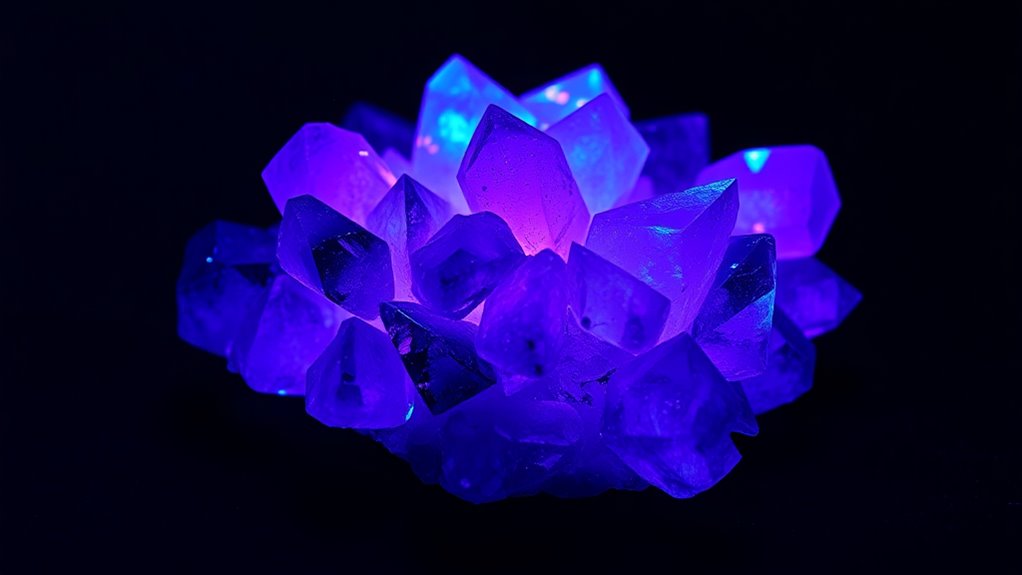
When you explore fluorescence in minerals, it’s essential to comprehend the interactions at the atomic level that cause this phenomenon. These interactions are governed by fluorescence theories, where electrons absorb ultraviolet light and become excited to higher energy states.
Upon returning to their ground state, they emit visible light, creating the enchanting glow you observe. This emission is key to mineral identification, as each mineral’s unique atomic structure dictates its fluorescent response.
The glow from returning electrons aids in identifying each mineral’s unique fluorescent signature.
Harnessing this knowledge empowers you to distinguish minerals with precision. By understanding how specific wavelengths affect different minerals, you gain the upper hand in identifying even the most elusive specimens.
Fluorescence acts as a beacon, guiding your journey through mineral exploration and enhancing your expertise in the field of geology.
The Unique Structure of Fluorite
Fluorite’s distinctive crystal lattice is an essential factor in its unique ability to fluoresce under ultraviolet light. Its atomic arrangement forms a cubic lattice structure, where calcium ions are symmetrically surrounded by fluoride ions.
This precise configuration creates numerous spaces for the dynamic interactions necessary for fluorescence. As ultraviolet light strikes the crystal lattice, it excites electrons within the atomic arrangement, causing them to jump to higher energy levels.

When these electrons return to their original positions, they release energy as visible light—hence the enchanting glow. The power of fluorite’s structure lies in its ability to facilitate this energy transformation efficiently.
Understanding these mechanisms gives you the insight required to appreciate the scientific elegance behind fluorite’s luminescent properties.
The Role of Impurities in Fluorite’s Glow
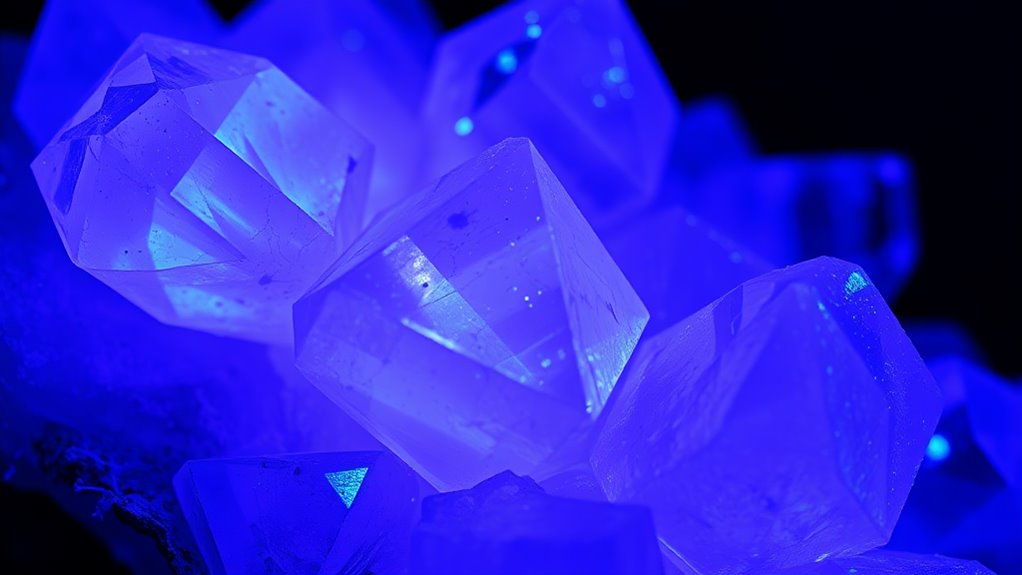
Although fluorite’s crystal structure plays a significant role in its fluorescence, impurities within the mineral can dramatically influence its glow.
You’ll find that specific impurity types, such as rare earth elements like europium and yttrium, are key players in this glowing phenomenon. These impurities can alter the energy levels within the fluorite, resulting in diverse color variations when exposed to ultraviolet light.
For instance, europium can create a mesmerizing blue luminescence, while manganese might lead to a subtle pink hue. The presence and concentration of these impurities determine the intensity and color of the fluorescence.
How UV Light Interacts With Fluorite
When you expose fluorite to UV light, it undergoes a fluorescence mechanism where the mineral absorbs energy, leading to electron excitation. This process involves electrons in the fluorite lattice absorbing high-energy photons, which temporarily raises them to higher energy states. As these electrons return to their ground state, they emit visible light, causing the characteristic glow you observe. Additionally, rainbow fluorite is known for its ability to clear negative energies, enhancing its appeal to those seeking both aesthetic and metaphysical benefits.
Fluorescence Mechanism Explained
Ultraviolet (UV) light, with its distinct wavelength, plays a crucial role in the fluorescence of fluorite. When you expose fluorite to UV light, it interacts with the mineral’s intrinsic properties, triggering a fascinating display.
Fluorite’s fluorescence types, primarily blue-violet, result from the presence of certain impurities and defects within its crystal lattice. These imperfections, often caused by trace elements like europium or yttrium, become centers of excitation under UV radiation.
When UV light strikes these centers, electrons get excited to higher energy levels. As these electrons return to their ground state, they emit visible light, manifesting as fluorescence.
Understanding these mineral properties empowers you to appreciate the intricate mechanisms at play, revealing the power of nature’s luminous spectacles.
Energy Absorption Process
As UV light interacts with fluorite, the energy absorption process begins with the transfer of energy to the mineral’s electrons. This energy transfer is pivotal, as it initiates the sequence leading to light emission.
When ultraviolet photons collide with fluorite, they impart their energy to the electrons, causing them to shift to higher energy states. This absorption of energy isn’t just a random act; it’s a calculated exchange governed by the mineral’s atomic structure.
The efficiency of energy transfer depends on the fluorite’s inherent properties, making it a unique and potent mineral. This precision and control over energy absorption guarantee that when these electrons eventually return to lower energy states, the resultant light emission is both vivid and powerful.
Electron Excitation Dynamics
Although the process might seem complex, understanding electron excitation dynamics in fluorite under UV light boils down to the interaction between photons and electrons within the mineral’s lattice structure.
When UV photons collide with fluorite, they impart energy to the electrons, forcing them to shift between energy levels. This electron shift is pivotal; it moves electrons from their ground state to an excited state.
The energy levels in fluorite’s lattice are quantized, ensuring that only specific shifts occur. Once electrons reach these higher energy levels, they don’t remain excited for long. They eventually relax back to their original state, releasing energy in the form of visible light.
This fluorescence phenomenon is a direct result of these precise electron shifts, creating the enchanting glow you observe.
Historical Observations of Fluorescent Minerals
You might find it fascinating that the phenomenon of mineral fluorescence was first documented in the early 19th century, greatly advancing mineralogical studies.
Pioneering geologists like Sir David Brewster made contributions by systematically studying fluorescence, providing foundational insights into mineral properties under UV light.
These early observations not only expanded our understanding of mineral behavior but also underscored the importance of fluorescence in geological investigations, influencing subsequent research and exploration.
Early Fluorescence Discoveries
In the 19th century, scientists first observed the enchanting phenomenon of fluorescence in minerals, with fluorite becoming one of the most well-documented examples.
Early mineralogy studies revealed how certain minerals, like fluorite, emitted visible light when exposed to ultraviolet radiation. These initial observations sparked intense curiosity, leading to the formulation of fluorescence theories.
Scientists aimed to understand the underlying mechanisms that caused this luminescent glow. By scrutinizing the atomic structure and composition, they discovered that electrons absorb energy from UV light, elevating them to higher energy states.
As they return to their ground state, they release energy in the form of visible light, creating fluorescence. This understanding empowered you to further explore and harness the enthralling properties of fluorescent minerals.
Pioneering Geologists’ Contributions
While examining the natural world, pioneering geologists made significant contributions to our understanding of fluorescent minerals through meticulous observations and detailed documentation.
You can appreciate how these geologist discoveries illuminated mineral fluorescence, transforming our perception of Earth’s hidden wonders. By analyzing the unique glow of minerals like fluorite under ultraviolet light, these trailblazers revealed secrets of atomic structure and elemental impurities.
Their methodical approaches revealed that fluorescence results from specific elements and defects within the crystal lattice.
These discoveries empowered you to decode the complexities of mineral fluorescence, enhancing your ability to manipulate and harness these phenomena for scientific advancements.
As a result, the groundwork laid by these geologists continues to inspire and direct modern exploration of mineralogical treasures.
Impact on Mineral Studies
Although the study of fluorescent minerals dates back centuries, its impact on mineral studies truly accelerated with historical observations that provided foundational insights into this phenomenon.
You can appreciate how these observations revolutionized mineral identification techniques, revealing the unique properties of minerals like fluorite under UV light.
As you explore deeper, you’ll uncover that this knowledge paved the way for advanced fluorite applications, such as using fluorescence to differentiate between similar-looking minerals.
Historic records of fluorescence in minerals catalyzed the development of sophisticated analytical tools, empowering you to precisely identify and classify minerals based on their luminescent characteristics.
The integration of fluorescence into mineralogical studies not only enhanced accuracy but also expanded the horizons of geological research and exploration.
Applications of Fluorite’s Fluorescence
Because of its unique ability to fluoresce under ultraviolet light, fluorite finds numerous applications across various fields.
In industrial applications, fluorite’s luminescent properties are harnessed for quality control processes. It helps detect impurities in materials, ensuring product integrity. You’ll appreciate how industries leverage this mineral to enhance manufacturing precision, giving them a competitive edge.
In artistic uses, fluorite captivates creators with its vibrant glow. Artists incorporate it into jewelry or decorative pieces, exploiting its aesthetic appeal to craft mesmerizing visual experiences.
You’re empowered to transform ordinary designs into extraordinary masterpieces, capturing attention and admiration. By understanding and utilizing fluorite’s fluorescence, you can reveal innovative possibilities, pushing the boundaries in both technical and creative domains.
The Importance of Fluorite in Geology
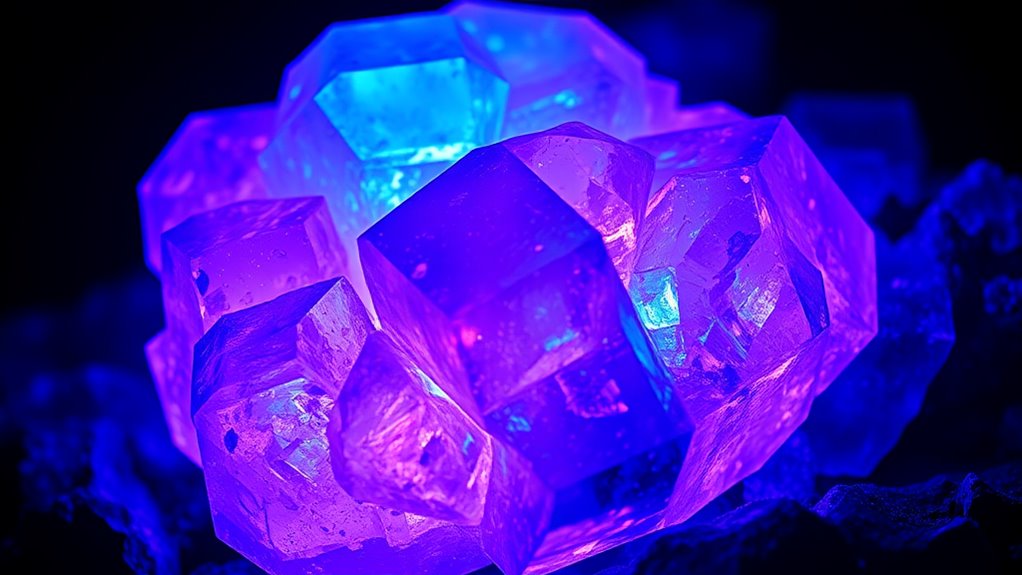
Fluorite, a versatile mineral, plays a significant role in geology due to its distinct properties and widespread presence. You’ll find that its geological significance is underscored by its classification as a halide mineral, which forms in hydrothermal veins, sedimentary deposits, and pegmatites.
Fluorite’s role in geology is marked by its distinct properties and classification as a halide mineral.
Its unique cubic crystal system aids geologists in identifying geological environments and tracking mineralization processes. Fluorite’s wide color range, from deep purple to clear, often indicates the presence of trace elements, providing insights into the geochemical conditions during its formation.
In mineral classification, fluorite serves as a benchmark for understanding mineral assemblages, helping you determine the thermal and chemical history of rocks.
Leveraging this mineral’s properties allows you to reveal critical geological data and wield influence over resource exploration strategies.
Exploring Other Fluorescent Minerals
While fluorite stands out for its geological significance and enchanting luminescence, it’s not the only mineral with fascinating fluorescent properties.
Calcite fluorescence, for instance, offers a striking visual experience. You’ll find that the presence of manganese ions can cause calcite to emit vibrant red or pink hues under UV light. This fluorescence occurs due to the specific energy shifts within the crystal lattice, providing a window into the mineral’s unique chemical interactions.
Willemite properties further expand the domain of fluorescent minerals. Under ultraviolet illumination, willemite, primarily found in zinc ores, radiates a brilliant green glow. This phenomenon arises from the presence of trace elements like manganese.
Conclusion
You’ve journeyed through the intriguing domain of fluorite, unraveling the secrets behind its enthralling glow. But here’s the thrilling part: the glow isn’t just a visual spectacle; it’s a dance of electrons, influenced by impurities and UV light. Each flicker tells a story of geological history and potential applications. As you explore deeper into the mineral domain, ask yourself: what other hidden wonders might await, silently glowing, ready to illuminate the mysteries of our Earth?

